Category: Uncategorized
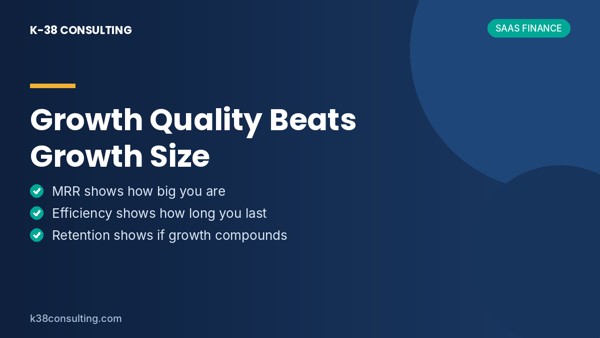
Beyond MRR: Essential SaaS Metrics That Reveal Long-Term Business Sustainability
A SaaS company may appear successful on paper while quietly moving toward a financial crisis. Monthly recurring revenue continues to increase, customer numbers look promising, and investor presentations show consistent growth. Yet, when the founder reviews the company’s cash position, there may be only nine months of runway remaining. This situation highlights a common problem

Fractional CFO for Medical Practices: Key Signs You Need One and the Benefits to Expect
A fractional CFO for a medical practice provides experienced financial leadership without requiring the organization to hire a full-time Chief Financial Officer. From cash flow forecasting and revenue cycle management to profitability analysis and strategic planning, this professional helps healthcare providers make informed business decisions while maintaining a focus on patient care. fractional CFO for
When Should a Small Business Hire a Financial Consultant?
A small business should hire a financial consultant when managing cash flow becomes difficult, financial reports are confusing, growth creates unexpected challenges, or major business decisions require more accurate financial analysis. Other warning signs include rising tax bills, plans to borrow money or raise capital, industry-specific financial challenges, and spending too much time managing spreadsheets.
Does Your Business Qualify for the R&D Tax Credit? A Plain-English
Your business may qualify for the federal Research and Development (R&D) tax credit if it spends time or money in the United States developing or improving a product, process, software, formula, or technique. The work must involve technical uncertainty and a process of testing or experimentation. Qualifying expenses generally include employee wages, research supplies, and
The Pre-Series A Financial Checklist Every Founder Should Complete
Before raising a Series A, founders should have accrual-based financial statements, a reliable monthly close process, a driver-based financial model, clearly defined growth metrics, a clean cap table, current tax filings and 409A valuations, an organized data room, and a use-of-funds plan tied to specific milestones. Completing these steps before the first investor meeting can
Fractional vs. Outsourced vs. Full-Time CFO: Which One Fits Your Business
The right CFO model depends on your company’s size, complexity, and pace of growth. A fractional CFO suits startups and smaller businesses that need strategic financial guidance a few days a month. An outsourced CFO team is ideal for growing companies that need both financial strategy and dependable accounting operations. A full-time CFO makes sense
Ecommerce Unit Economics: The Numbers Every DTC Founder Should
Direct-to-consumer (DTC) founders should track essential financial metrics every week to understand whether their ecommerce businesses are growing profitably. These metrics include contribution margin per order, customer acquisition cost (CAC), marketing efficiency ratio (MER), average order value (AOV), repeat purchase rate, customer lifetime value (LTV), CAC payback period, return rate, inventory levels, and available cash.
From Shelf to Scale: Managing Margins and Inventory in a Fast-Growing
Fast-growing consumer packaged goods (CPG) brands protect their profits by understanding the true cost of every product, monitoring retailer deductions, setting prices for each sales channel, and managing inventory according to accurate demand forecasts. These financial practices help businesses expand into new retail markets without running out of cash or sacrificing profitability. Winning a new
Bonding Capacity Explained: How Contractors Can Qualify for
Bonding capacity is the maximum amount of bonded work a surety company is willing to support for a contractor. It is usually measured through two limits: the maximum value of a single project and the total value of all ongoing bonded projects. Contractors can increase their bonding capacity by improving financial statements, strengthening working capital
7 Job Costing Mistakes That Quietly Kill Contractor Margins
Contractors lose profit through job costing mistakes that often go unnoticed until a project is complete. Common problems include outdated labor burden rates, untracked change orders, poor overhead allocation, incorrectly coded expenses, delayed cost reviews, ignored overbilling and underbilling, and equipment costs that are left out of project budgets. Correcting these mistakes helps contractors understand